
With photovoltaics and storage, 53 percent of all single-family homes in Europe could become completely energy self-sufficient
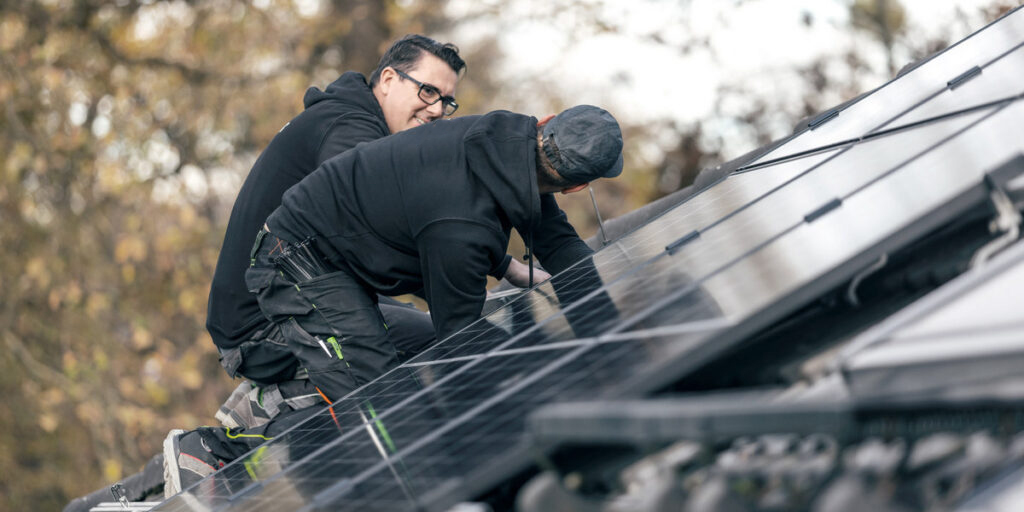
Thanks to photovoltaic systems and battery storage, millions of households in Europe are already partially self-sufficient. How big would be the step towards complete self-sufficiency - and how big is the potential across all single-family homes? This is what researchers from the Karlsruhe Institute of Technology (KIT), the Research Center Jülich as well as the Swiss Federal Institute of Technology Zurich (ETH Zurich) and the Paul Scherrer Institute in Switzerland calculated.
The basis for their calculations is a database in which geographically high-resolution information on the European building stock and the households living in them was combined with local climatic and economic conditions. By using novel methods to reduce complexity on high-performance computers, cost-optimized, energy-autonomous supply systems were initially configured for 4,000 representative single-family homes. In a further step, neural networks were then used to transfer the results to the 41 million single-family homes examined.
“Under today’s conditions, 53 percent of the 41 million buildings are technically capable of powering themselves through the use of local rooftop solar radiation alone, independent of external infrastructure, and this share could rise to 75 percent by 2050 due to improved technologies,” says Professor Russell McKenna from ETH Zurich and head of the Laboratory for Energy Systems Analysis at the Paul Scherrer Institute. “If you now assume that building owners would be willing to invest up to 50 percent more than would be necessary for a comparable energy system with a grid connection, then up to two million single-family homes could leave the power grid by 2050.”
Decoupling from the network does not make sense from a system perspective
The researchers see significant potential for energy self-sufficient residential buildings, especially in regions with low seasonal weather fluctuations, for example in Spain, or with high electricity prices, such as in Germany. Electrolysis plays a central role in the design of cost-optimized systems: “Our results show that a successful, cost-optimal and self-sufficient energy supply system for buildings in Central Europe will consist of photovoltaics for electricity generation as well as a combination of short-term battery storage and a long-term, seasonal hydrogen storage system,” says Jann Weinand, head of department at the Research Center Jülich.
The question that remains, among other things, is whether a large-scale spread of completely self-sufficient supply systems that are decoupled from the grid actually makes sense from an energy system perspective. After all, single-family homes can play an important role in stabilizing an energy system based on renewables - for example by shifting loads, feeding in solar power as needed or providing balancing energy.
PRODUCT
 PV solar panel manufacturing downturn to extend into 2026
  SUSTAINABLE DEVELOPMENT BY INDUSTRY STANDARDS
  Maxeon posts US$14.9 million losses in delayed Q1 ’24 results
  Chinese PV Industry Brief: New PV hit 36.72 GW in January-February period
  How to maintain solar panels
  How to Installing solar panels?
  What are the types of solar panels?
  Small-scale solar good for environment, but agrivoltaics might be better
  Module prices steady as market mulls price hikes
  China solar cell prices decline on sluggish downstream demand
  Four rooftop solar trends in 2023
  Photovoltaic expansion in 2023: Germany will reach 14 gigawatts, Europe will reach 56 gigawatts
  Module prices in China fall to new all-time low and manufacturers reduce production
  European Solar production a mixed bag in November due to Baltic Low Pressure, Storm Ciarán
  Renewables helping China to halve power prices compared to US, Europe
  Chinese module prices have reached historic lows, operating percentages are estimated at around 60%
  Summer-autumn-winter-spring: the Italian electricity market is the most expensive in Europe
  Europe to add 58 GW of solar in 2023
  State of the Energy Union 2023, it is necessary to accelerate investments in renewables
  Austria slashes VAT on residential PV